Talking Transition pioneered a new model of civic engagement during a pivotal moment in democratic government: the transition to a new administration. Following the 2013 mayoral election in New York City, tens of thousands of New Yorkers came together online, in the streets, and in a central pop-up “think tent” to inform the priorities of newly elected and appointed officials citywide. On the occasion of Talking Transition’s one-year anniversary, we engaged the Center for Urban Research at CUNY’s Graduate Center to comb through hundreds of hours of video from tent discussions to identify and collect ideas raised by participants. See what happened, analyze the data, and learn about the ideas New Yorkers have for making their city government work better.
Over a two-week period in November of 2013, Talking Transition hosted more than 120 events in its tent on Canal Street, which were organized by 97 event hosts and engaged 482 conversation leaders. Included in this were discussions of policy proposals for the new administration to consider, more open, interactive conversations about some of the most pressing issues facing the City during this time of transition in government, and cultural events of all shapes and sizes.
Although the experience in the tent was ever-changing, Talking Transition and the Center for Urban Research at CUNY’s Graduate Center have organized the recordings and ideas from these events into 11 issue areas. You can read the full report from the Graduate Center on the ideas and questions raised in the tent, and you can also click below to learn more about the issues, watch events, meet conveners, and view New Yorkers’ opinions on the Community Vision Wall and Soapbox.


Talking Transition is an unprecedented community engagement initiative that pioneered the first “open” transition to a new citywide administration in New York City history. Talking Transition is an experiment in innovative government and grass-roots organizing that seeks to transform the typically insular, closed-door process between Election Day and Inauguration into an opportunity for broad civic discourse. Following the 2013 mayoral election in New York City, Talking Transition brought thousands of New Yorkers together to join open conversations about the most pressing public policy issues, ideas, and questions that affect communities across the city. Over the course of more than two weeks, starting immediately after Election Day, Talking Transition created a forum for these discussions by hosting live events in a pop-up on Canal Street, open to the public 9AM to 9PM daily, and by bringing the conversations to neighborhoods across all five boroughs through mobile “tents” and a team of more than 100 canvassers speaking 19 different languages.
READ MORE >
Talking Transition is about demonstrating a new process of broad civic engagement that leverages traditional grass roots organizing tactics with open forums in digital media and public spaces. The idea is to leverage the momentous occasion of a democratic election to keep the citizenry involved in the process of policy-making after the votes are counted.
With an expansive data project, Talking Transition is enabling elected officials to understand popular sentiment about policy at a more nuanced level than available during an election, and to govern with an eye towards the sentiment of the populace as a whole, reaching beyond the voting public. With an open tent filled with interactive events convened by organizations from throughout the city and across the ideological spectrum, Talking Transition is bringing onto the public stage the policy proposals and ideas that typically make their way to elected officials through closed-door meetings and back channels, giving advocates – from community groups to experienced practitioners – an expansive forum for presenting their ideas publicly, and bringing more New Yorkers into the conversations they are leading.
Talking Transition conversation leaders included elected officials, policy experts, industry groups, public service providers, neighborhood groups, advocacy organizations, and students. Programming included the presentation of specific policy proposals for the new administration to consider, more open discussions about some of the toughest choices that the new administration will need to make, cultural programs that showcase the diversity of the city and the impact of the arts, and a culminating Town Meeting in which 500 New Yorkers voted on specific recommendations for the new administration.
Talking Transition is brought to New York by several foundations with deep investments in New York City including: Open Society Foundations, Ford Foundation, Rockefeller Brothers Foundation, New York Women’s Foundation, New York Community Trust, New York Foundation, North Star Fund, Atlantic Philanthropies and the Brooklyn Community Foundation. Partnerships with the city's three library systems helped expand the impact of the project, bringing conversations directly to these invaluable community centers. The Talking Transition initiative was designed and managed by HR&A Advisors, Inc., supported by a broad array of specialized producers and service providers.






 Nov 22nd, 6:30PM


TalkNYC:
A Digital Experience That Brings New Yorkers’ Assessment Of Their City To Life
Following the 2013 New York City elections, Talking Transition yielded one of the most expansive public opinion surveys in the city’s history. Nearly 70,000 people weighed in on City services and other quality of life issues that City government has influence over. Answering between five and fifty questions, in one of seven languages, these participants – including both visitors and a robust and representative sample of New York City residents – logged their sentiments on nine categories of issues in their neighborhoods and the city as a whole in terms of how good or bad the current state of the issue is, and whether it has been getting better or getting worse. The results were clear:
READ MORE >
A single concern unites the city: New Yorkers cannot afford the housing in their neighborhoods, and the problem is getting worse. In every neighborhood, in every age group, from lifelong residents to recent arrivals, New Yorkers feel more strongly about the unaffordability of housing in their neighborhood than about any other issue. Two thirds of New York City residents say that housing affordability in their neighborhood is bad and getting worse. The prevailing sentiment in every neighborhood across the city is that housing is unaffordable, presenting an acute crisis for the administration. Only 14% of New Yorkers say it is not a concern in their neighborhoods.
When it comes to finding quality jobs, the tale of two cities is abundantly clear. More than 50% of New Yorkers say their ability to find a good job is bad and getting worse. The sense of crisis is most acute in the Bronx, Queens, Upper Manhattan, and Brooklyn outside of the “brownstone” neighborhoods. Middle-aged New Yorkers are more concerned than are other age groups, but younger adults acknowledge a worrisome trend – although slightly more of them believe their ability to find quality jobs is currently good, they are concerned that their prospects are getting worse.
On all other issues, the dominant sentiment citywide is that the City’s performance is adequate. Although every neighborhood has its own priority issues, in six out of the nine policy categories covered by the Talking Transition survey, New Yorkers as a whole feel that the City is doing okay in their neighborhoods. In each of these policy categories, the sentiment is that things are trending moderately better. Of these six categories, New Yorkers feel that parks and open spaces are performing best and, along with health and human services and transportation, heading most strongly in the right direction. Trends are also moderately positive when it comes to education, the environment, and law enforcement citywide, although there are deep divides along geographic lines when it comes to policing.
Many of the challenges confronting the new administration are place-based. The Talking Transition survey reached deep into neighborhoods frequently underrepresented in policy-making circles, in large part thanks to a field team of more than 100 canvassers, speaking 19 different languages, and active for two weeks across the city. Certain issues that do not present critical challenges citywide are pressing issues in particular pockets of the city. Police-community relations elicit deep dissatisfaction in Central Brooklyn, the South Bronx, and Upper Manhattan, in stark contrast to more positive sentiments across much of the rest of the city. In the South Bronx, the only issue on which residents are more positive than negative is health and social services. In the West Village, on the other hand, residents are critically concerned with access to health care.
On the other hand, very few variances in opinion can be attributed to age, tenure of residency in the city, or whether or not respondents had voted in the election. Among the few exceptions to this rule is the difference in perspective on jobs and economy between recent New Yorkers and longtime or lifelong New Yorkers – recent arrivals are 10% less pessimistic, as might be expected.
Where the City is perceived to be doing well, New Yorkers believe things are generally getting better; where it is believed to be doing poorly, things are generally considered to be getting worse. In question after question, New Yorkers’ expressed the sense that City services that are currently being performed well have been getting better, and services that residents are less satisfied with have been getting worse. Very few New Yorkers believe there are areas of City policy and services that are currently good but are getting worse, or are currently bad but are getting better.


Orbs of Energy

Ships, on ships, on ships

Ships, on ships, on ships

Ships, on ships, on ships

Ships, on ships, on ships

Ships, on ships, on ships

Ships, on ships, on ships

Ships, on ships, on ships

Ships, on ships, on ships

Ships, on ships, on ships

Ships, on ships, on ships

Ships, on ships, on ships

Ships, on ships, on ships

Ships, on ships, on ships
Darker colors correspond to stronger trends. Dots correspond to counter trends, denoting where a neighborhood believes an issue is getting better, even if currently bad, or vice versa. Neighborhoods in grey have less than 5% response rates.
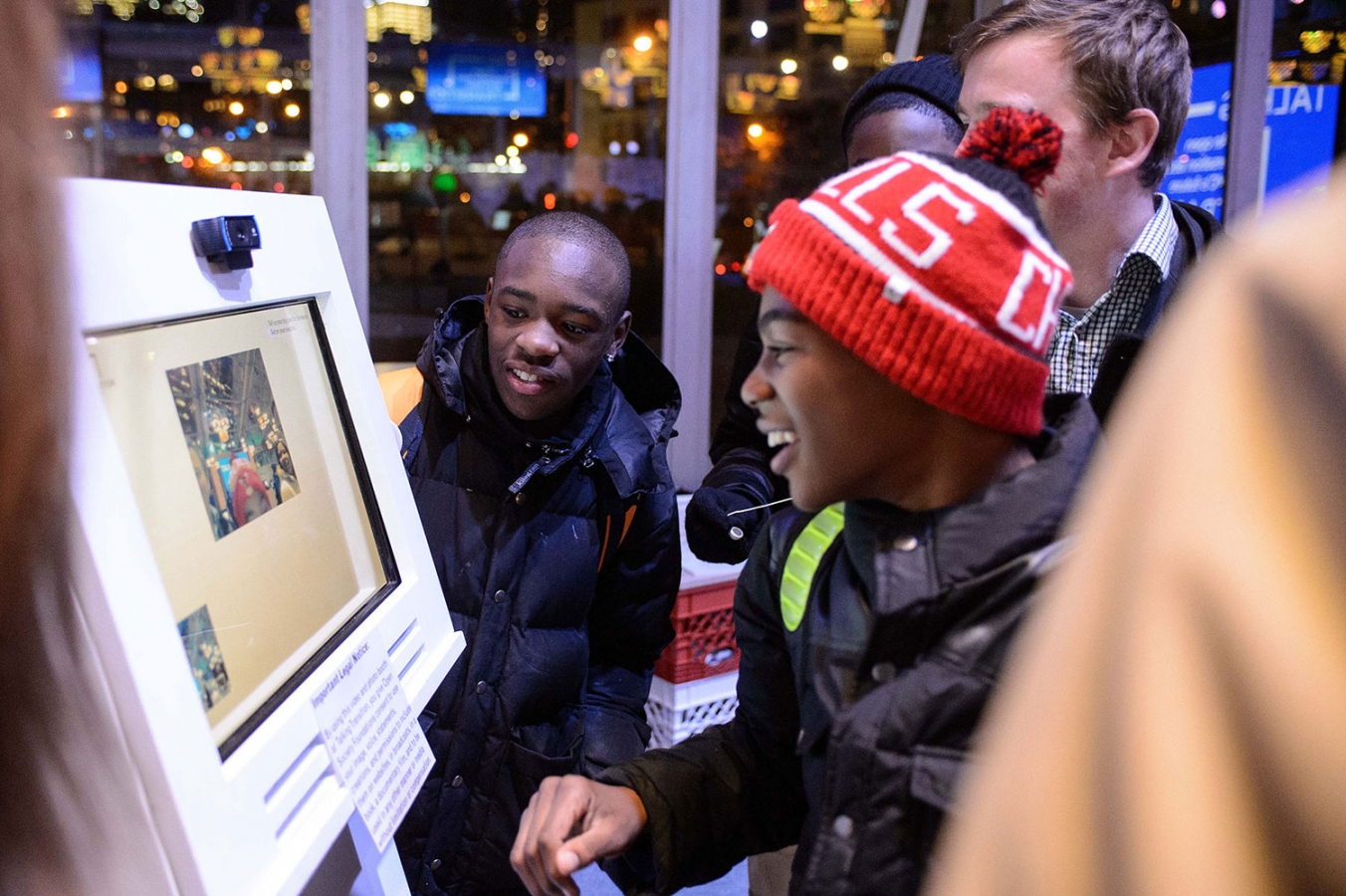
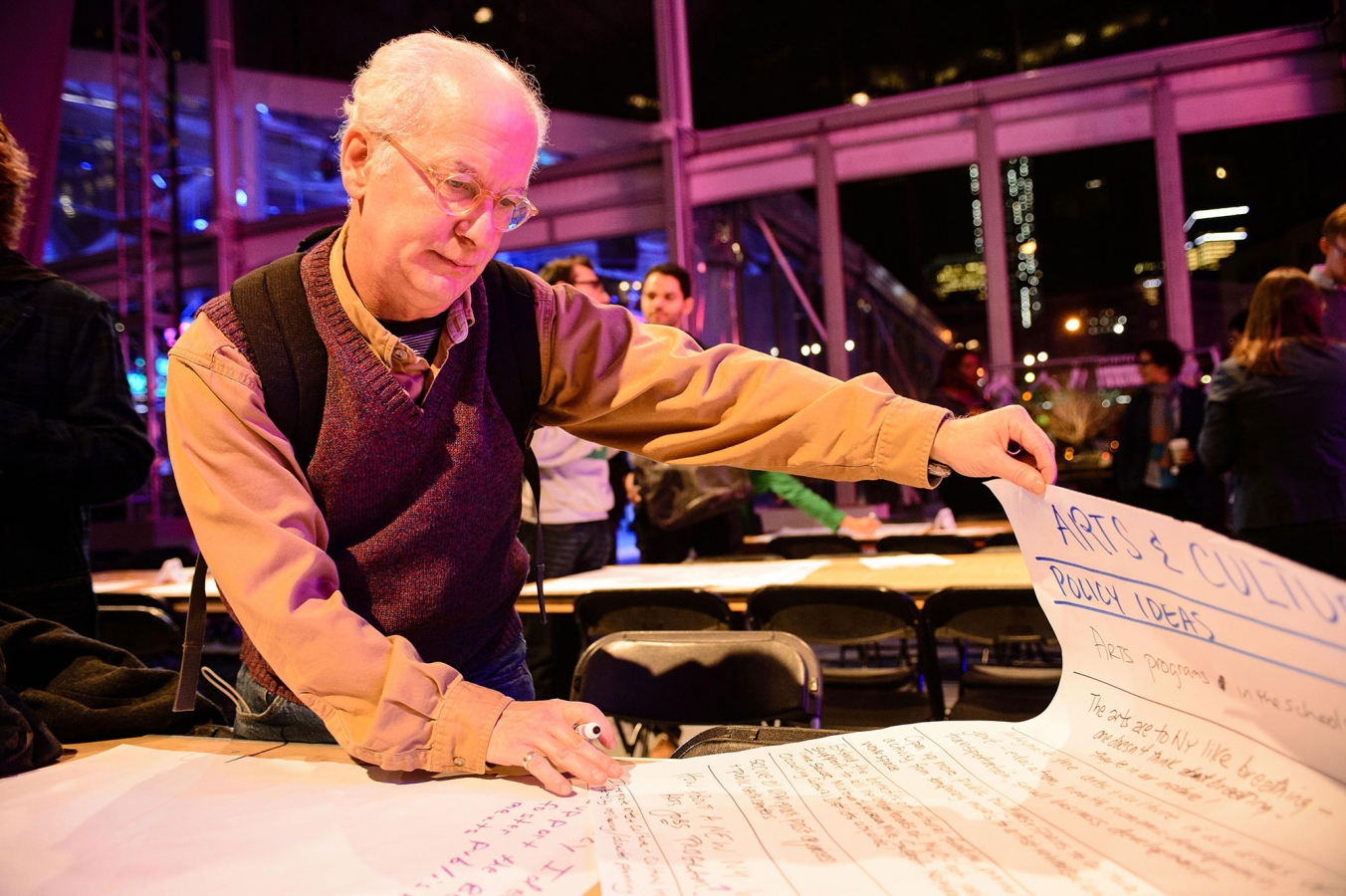
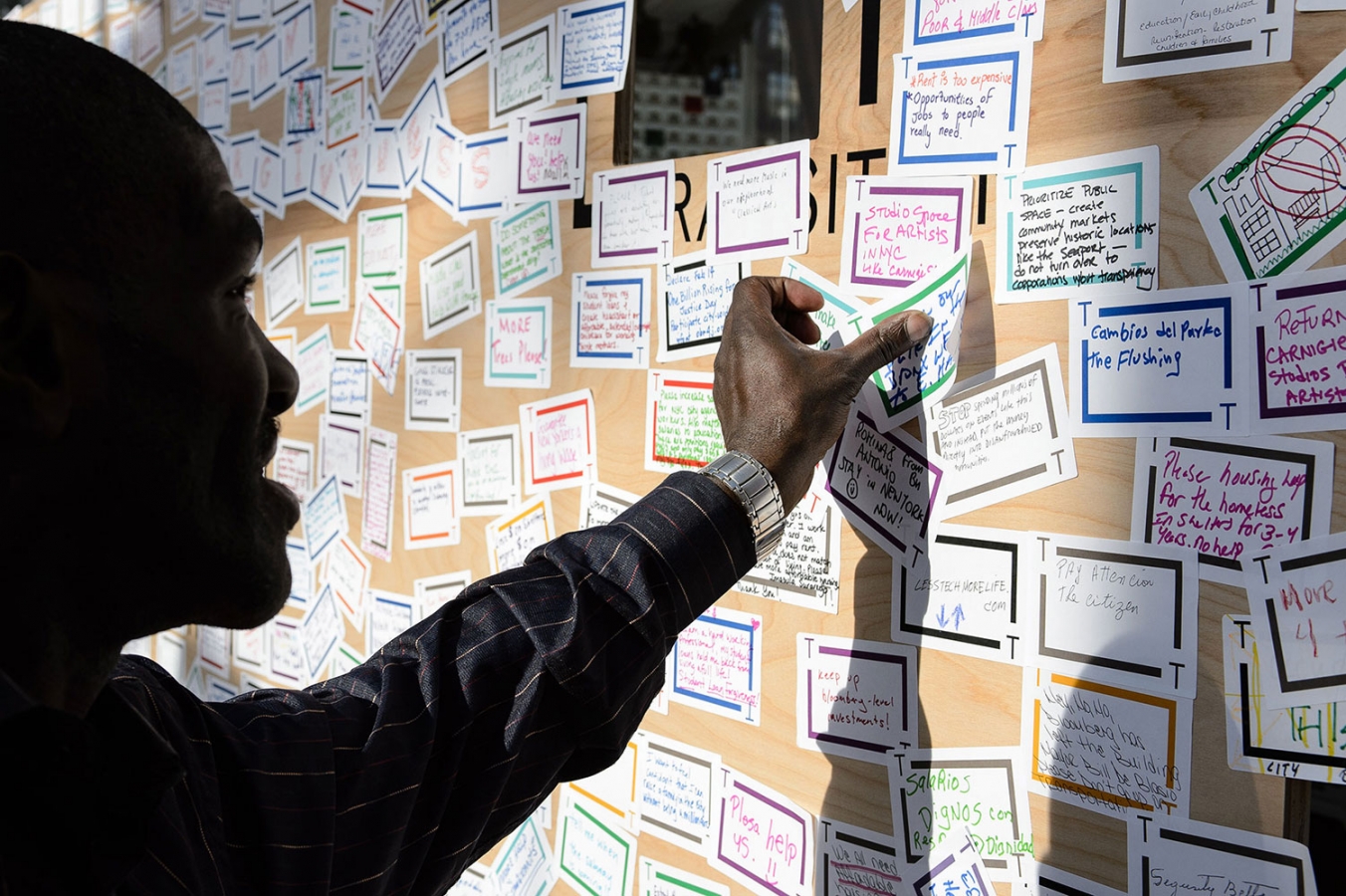
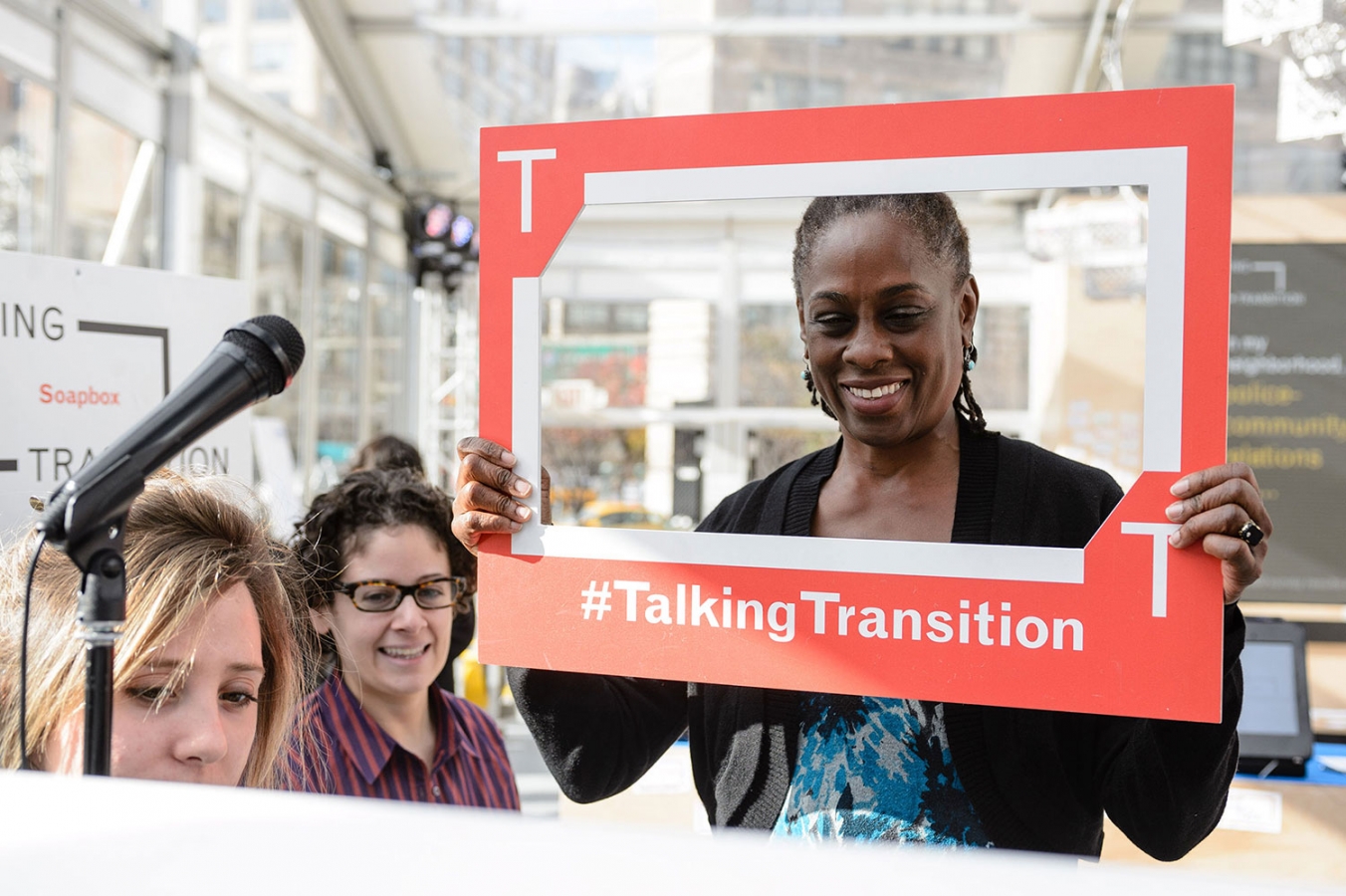
The Talking Transition pop-up tent on Canal St. & 6th Ave. served as the central location for the initiative and an open forum for all New Yorkers to stop in at any time to have their voices heard. The 15,000 square foot tent was built to serve as a gathering place for anyone seeking to talk about transition in the city, and as a flexible meeting space to host events of all sizes -- from an intimate discussion of a dozen New Yorkers, to a Town Meeting of more than 500 people. In addition to a Town Hall that served as the forum for large Talking Transition events, the tent included an open Forum in which visitors could record their message for newly-elected officials on a Video Soapbox, log their policy ideas and wish list on stickers posted to a community vision wall called "Wall Talk," contribute to the Talking Transition Data Project by taking the survey, and view the data and social media trends in real time on dynamic media displays. A breakout room with the "Coffee Talk" cafe played host to more informal and intimate programs.


See New Yorkers’ big ideas for the City.

This community vision wall has 5,000 stickers about policy.

We hosted 120 events to elevate policy solutions to NYC problems

474 speakers shared their ideas on the stage in the tent.
On Saturday, November 23, 2013 Talking Transition convened a Town Meeting in its tent on Canal Street. More than 500 diverse New Yorkers from all five boroughs came together for a communal conversation about three important issues facing New York City’s newly-elected mayor, Bill de Blasio, and his transition team – issues that affect the lives of almost all residents of the city: housing affordability, police-community relations, and building a quality public school education. The event culminated in votes for which of the Mayor’s proposed policies New Yorkers want the administration to prioritize, and which policies they want to see the administration add to its agenda.
Check out the 482 participants who appeared on stage in the Talking Transition tent, helping to lead conversations and inform policy. Read about these civic leaders, view their events, and get involved in supporting their missions for making our city a better place.
-
- Name
- Title
- Organization
- Bio
- Event 1
- Event 2
-
-
-
-
-
-
-
-
-
-
-
-
-
-
-
-
-
-
-
-
-
-
-
-
-
-
-
-
- Alice Quinn
- Executive Director
- Poeuly Society of America
- Event
-
- Annalyn Swan
- Journalist & Editor
- Event
-
- Ed Hirsch
- Author & Educator
- Event
-
- Henry Chang
- Author
- Event
-
- Jennifer Benka
- Executive Director
- Academy of American Poets
- Event
-
- John Oakes
- Co-Founder
- OR Books
- Event
-
- Linda Marshall
- Children's Book Author
- Event
-
- Maaza Mengiste
- Author
- Event
-
- Margaret Carson
- Translator
- Event
-
- Marie Howe
- Poet Laureate
- New York State
- Event
-
- Martha Cooley
- Author & Educator
- Event
-
- Masha Hamilton
- Journalist & Author
- Event
-
- Meena Alexander
- Author & Educator
- Event
-
- Monica Strauss
- Biographer
- Event
-
- Philip Turner
- Publishing Executive
- Event
-
- Richard Nash
- Publisher
- Red Lemonade
- Event
-
- Rob Spillman
- Editor-in-Chief
- Tin House magazine
- Event
-
- Selene Castrovilla
- Children's and Young Adult's Book Author
- Event
-
- Sergio De La Pava
- Author
- Event
-
- Susan Bernofsky
- Author & Translator
- Event
-
-
- Tina Chang
- Poet Laureate
- Brooklyn
- Event
-
- Tina Jordan
- Vice President
- Association of American Publishers
- Event
-
- Vicki Cobb
- Author & Founder
- iNK Think Tank
- Event
-
-
-
-
-
-
-
-
-
-
-
-
-
-
-
- Robin Pogrebin
- Journalist
- The New York Times
- Event
-
-
-
-
-
-
-
-
- Madalena Tran
- President, Coalition for the Revitalization of Asian American Studies at Hunter
- CUNY
- Event
-
-
-
-
-
-
-
-
-
-
-
-
-
-
-
-
-
-
-
- Chuck Brecher
- Professor of Public and Health Adminisulation
- New York University
- Event
-
- Michael Jacobson
- Director
- CUNY Institute for State and Local Governance
- Event
-
-
-
-
-
-
-
-
-
-
-
-
-
-
-
-
-
-
-
-
-
-
-
-
-
-
-
-
-
-
-
-
-
-
-
-
-
-
-
-
-
-
-
-
-
-
-
-
-
-
-
-
- Magda Barbosa
- Supervising Attorney
- Make the Road New York
- Event
-
-
-
-
-
-
-
-
-
-
-
-
-
-
-
-
- Charzel McGill
- College student
- Event
-
-
- Damion Samuels
- Director of Employment Works
- Fedcap
- Event
-
-
-
- Kevin Cordero
- GED Student
- Future Now
- Event
-
-
- Stacy Soria
- Manager, Veteran's Program
- The Doe Fund
- Event
-
- Terrence Coffie
- Computer Lab Manager
- The Doe Fund
- Event
-
- Trevor Mobley
- Student
- Getting Out and Staying Out
- Event
-
-
- Yolanda Johnson-Peterkin
- Director of Operations, Re-Entry Services
- Women's Prison Association
- Event
-
-
-
-
-
-
-
-
-
-
-
- Nancy Mann
- Principal
- Fannie Lou Hamer Freedom High School
- Event
-
-
-
-
-
-
-
-
-
-
-
-
-
-
-
-
- Benia Cullins
- Member, Food Justice Team
- Make The Road New York
- Event
-
-
- Iyeshima Harris
- Member, Food Justice Team
- Make The Road New York
- Event
-
- Kristina Erskine
- Member, Food Justice Team
- Make The Road New York
- Event
-
-
-
-
-
-
-
-
-
-
-
-
-
-
-
-
-
-
-
-
-
-
-
-
- Lisa Cowan
- Researcher & Board Chair
- Red Hook Initiative
- Event
-
-
-
-
-
-
-
-
-
-
- Pat Tubridy
- Principal
- Channel View School for Research
- Event
-
-
- Richard Stopol
- Chief Executive Officer
- NYC Outward Bound Schools
- Event
-
- Ann Christensen
- President
- Clayton Christensen Institute for Disruptive Innovation
- Event
-
-
-
-
-
-
-
-
-
-
-
-
-
-
-
-
-
-
-
- Mery Melendez
- Charter School Parent & Organizer
- Families for Excellent Schools
- Event
-
-
- Mitch Brenner
- Assistant Principal, Character Education
- KIPP Academy Middle
- Event
-
-
- Shamona Kirkland
- Charter School Parent & Organizer
- Families for Excellent Schools
- Event
-
-
- Al Hagan
- President
- Uniformed Fire Officers Association
- Event
-
- Bob Master
- Legislative and Political Mobilization Director
- Communications Workers of America
- Event
-
-
-
-
-
-
-
-
-
-
-
-
-
-
-
-
- Carla Lalanne
- The Best Beauty Salon, Inc.
- Event
-
- Curtis Maraja
- Gentleman’s Quarters Salon
- Event
-
- Ernie Smith
- Penn & Fletcher
- Event
-
- Fabiola Santos-Gaerlan
- HoneyDew Drop
- Event
-
- Henry Lee
- HD Made
- Event
-
- Jede Brahma
- LP’n Harmony Bar
- Event
-
- Philippe Massoud
- ilili NYC
- Event
-
- Raquel Salas
- Big City Graph-x
- Event
-
- Samantha Bailey Champagnie
- Golden Krust
- Event
-
-
-
-
-
-
-
-
-
-
-
-
-
-
-
-
-
-
-
-
-
-
-
-
-
-
-
-
-
-
-
-
-
-
-
-
-
-
-
-
-
-
-
-
-
-
-
-
-
-
-
-
-
-
-
-
- Ramatoula Gassama
- Bronx 8th grade Public School Student
- Event
-
-
-
- Umamah Masum
- Staten Island 8th grade Public School Student✥✖
- Event
-
- Christy Parque
- Executive Director
- Homeless Services United
- Event
-
- Paulick Markee
- Senior Policy Analyst
- Coalition for the Homeless
- Event
-
-
-
-
-
-
-
-
-
-
-
-
- Goldi Guerra
- Chair, Long-Term Recovery Organization Mission
- Occupy Sandy
- Event
-
- Joe Pupello
- President
- Zone A New York
- Event
-
- Pat Kane
- Chair, Long-Term Recovery Organization Health
- New York State Nurses Association
- Event
-
- Rev. Karen Jackson
- Long-Term Recovery Organization Coordinator
- Project Hospitality
- Event
-
- Rev. Terry Troia
- Long-Term Recovery Organization President
- Project Hospitality
- Event
-
- Daryl Denizard
- Participant
- P.S. 64 Beacon
- Event
-
-
- Hélène Onserud
- Program Director, Center for Family Life
- SCO Family of Services
- Event
-
- Jim Matison
- Executive Director
- Brooklyn Kindergarten Society
- Event
-
-
-
-
-
-
-
-
-
-
-
-
-
-
-
-
-
-
-
-
-
- Bre Pettis
- Chief Executive Officer
- Maker
- Event
-
-
-
-
-
-
- Roger Krulak
- Senior Vice President
- Forest City Ratner
- Event
-
-
-
-
- Cosino
- Under Da Rock Radio
- Event
-
-
-
-
- Ariel Ferreira
- Member, Licensing Committee
- Community Board 12
- Event
-
-
-
-
- Londel Davis
- Founder & Chief Executive Officer
- American Fire Conulol
- Event
-
-
-
-
-
-
-
-
-
-
-
-
-
-
-
-
-
-
-
-
-
-
-
-
-
-
-
-
-
-
-
-
-
-
-
-
-
-
-
-
-
-
-
-
-
-
-
-
-
-
-
-
-
-
-
-
- New York Today: Hey, Mr. Mayor-Elect New York Times
- Coalition Seeks Public’s Advice on New York City’s Goals New York Times
- Talking Transition Tent Seeks Input from New Yorkers NY1
- A Clever Way for New Yorkers to Give De Blasio a Piece of Their Mind The Atlantic Cities
- Piden participación de la comunidad en transición El Diario La Prensa
- Talking Transition Tent Opens for New Yorkers to Discuss Priorities in the Next Administration NY1
- Latinos juntos 'Hablando de la Transición' en NYC El Diario La Prensa
- Panel At Transition Tent Discusses Growing Role of Ethnic Media in NYC NY1
- Bill de Blasio's Transition Chairs Visit "Talking Transition" Tent NY Daily News
- Groups Pick New Yorkers’ Brains, Pass Feedback To De Blasio CBS New York/AP
- Talking Transition: Mayor- Elect De Blasio Gets and Earful From Writers Huffington Post
- Leave an Idea, Take an Idea New York Times
- De Blasio to stop by 'Talking Transition' tent AP
- De Blasio Visits the Talking Transition Tent -- Names Transition Team WNYC
- Parks and Accumulation The New Yorker
- Talking Transition: See photos, video of New Yorkers’ priorities for the mayor Time Out New York
- De Blasio Talks With 3 Candidates for Police Commissioner New York Times
- The Big Man Comes to the Big Top NY1
- Bill de Blasio talks transition in downtown tent Metro
- Bill de Blasio says transition is going well WABC
- Bagels and de Blasio: Can New York's Next Mayor Advance City Food Beyond Bloomberg? Huffington Post
- Q&A: The Man Behind the Talking Transition ‘Think Tent’ Spills His Secrets NY Mag
- Talking Transition Tent Closing Down With New Yorkers Optimistic About Future NY1


